Peugeot Expert Campervan Conversion: Insulating and Installing Vinyl Flooring
- May 6, 2025
- 4 min read
Updated: Jan 16

Welcome to the third installment of our camper conversion series! In this post, we'll start by guiding you through the process of insulating your van's floor. Once the insulation is in place, we’ll move on to reinstalling the plywood flooring before finishing off with the vinyl. You'll find a step-by-step guide along with helpful tips and tricks for your own conversion project.
A full walkthrough video is included at the bottom of the page.
What You'll Need
Item List
Tools Used
Electric screwdriver
Stanley blade
Scissors
Fabric scissors
Measuring tape
Step One: Measuring Insulation
For this step we used:
10mm Sound deadening/insulation roll
Measuring tape
Scissors
Aluminium foil tape



After removing the plywood floor in part one of the series, we're were left with a blank canvas to work with.
We started by measuring around the trim and wheel arches of the van. Like in previous steps of the conversion, we used cardboard to transcribe the shapes onto the insulation to make sure we'd get a good fit.
After we were happy with our first measurements, we moved on to the back side of the van.
At the far end of the van, we measured around the trim that would remain exposed, this time drawing the markings on the reverse side by eye.
Step Two: Installing the Insulation

After the insulation was cut to shape, we separated the piece into two sections. This would make the installation easier and allow us to make adjustments where needed.



Once we were happy with the measurements, we were ready to stick down our first pieces.
Note about our method
I avoided using a wooden frame on the floor as I didn't want to lose any headspace. Initially, the plan was to use 10 mm wood to leave space for the insulation, but after realizing the ribs in the van's floor were around the same size, I didn't want to raise the floor any more than needed.
This ended up making reinstalling the floor more difficult later on, as we needed to drill extra holes to ensure the warped plywood sat level when fastened. If I were to do this again, I would glue a wooden frame down and screw into that instead.

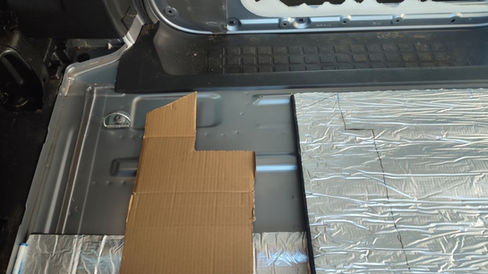


After that, we focused on insulating the remaining exposed areas of the floor. To minimise waste, we cut the insulation into smaller pieces, the width of the insulation roll, rather than one long piece.
Once the floor was completely covered, we applied aluminium foil tape along the seams where th pieces met, completing the final step of the insulation process.
Step Three: Cutting Out The Vinyl Flooring
Tools used:
Fabric scissors
Stanley knife
Pen
We started by laying down the vinyl flooring and then placed the original plywood floor on top.
Using the plywood as a stencil, we traced its shape onto the vinyl.
Next, we used fabric scissors to cut out the majority of the vinyl floor before switching to a Stanley knife to cut the holes for the circular mounting points.

Step Four: Installing Vinyl Flooring Into The Van
Tools used:
Adhesive spray x2
Level or metre stick to flatten out the floor
Fabric scissors/knife for adjustments
After cutting out the vinyl flooring, the next step was to reinstall the plywood floor in the van.
Once the plywood was back in the van, I placed duct tape over the point where the two sections met to make the surface smoother before installing the vinyl.
I rolled out the vinyl and checked if it fit correctly, making some adjustments around the wheel arches, which were now a little narrower after the insulation was installed.
We began by applying adhesive spray to the surfaces at the front end of the van after ensuring everything was lined up correctly. Once that first section was firmly in place, we rolled up the flooring and continued applying adhesive, working our way back in sections. I'd recommend using a long, flat object, such as a metre stick or a level, to smooth out the floor as you lay it down to avoid any bumps or bubbles.
Tip: Make sure to use high temperature resistance adhesive spray.
Once the floor was fully adhered, I used a Stanley knife to trim the edges so there was no overhang, which would make installing the protective trim easier later on.
Step Five: Installing Trim
The first step was to measure and cut the upper section of the trim. I made cuts at each point where the trim would need to bend.
When there were the bends would cause the trim to fold over itself; I marked the point where they met and used this marking to cut out a V-shape. This would allow the pieces to fit together smoothly.
Once I was confident with the measurements, I started sticking down the top section of the trim. I did this part first because it would be the most visible. Since these top sections were cut, I was able to remove the adhesive tape piece by piece and stick down each part individually.
After the entire top section was fully securely in place, I removed the tape from the lower section, which peeled off in one continuous strip.

I then wedged the trim down firmly to make sure it would stick properly. Finally, I filled in the gaps that were created when the trim was bent at an angle. I filled these gaps in by cutting small pieces from the unused trim and placing them in the openings. I used a small amount of adhesive spray to secure these pieces and cleaned up any excess with acetone after they were fully set.
What's Next?
In the next instalment of our campervan conversion series, we’ll be installing a roof vent for improved airflow in the van. For more van content, visit my YouTube channel here.


Comments